THE CIRCUIT
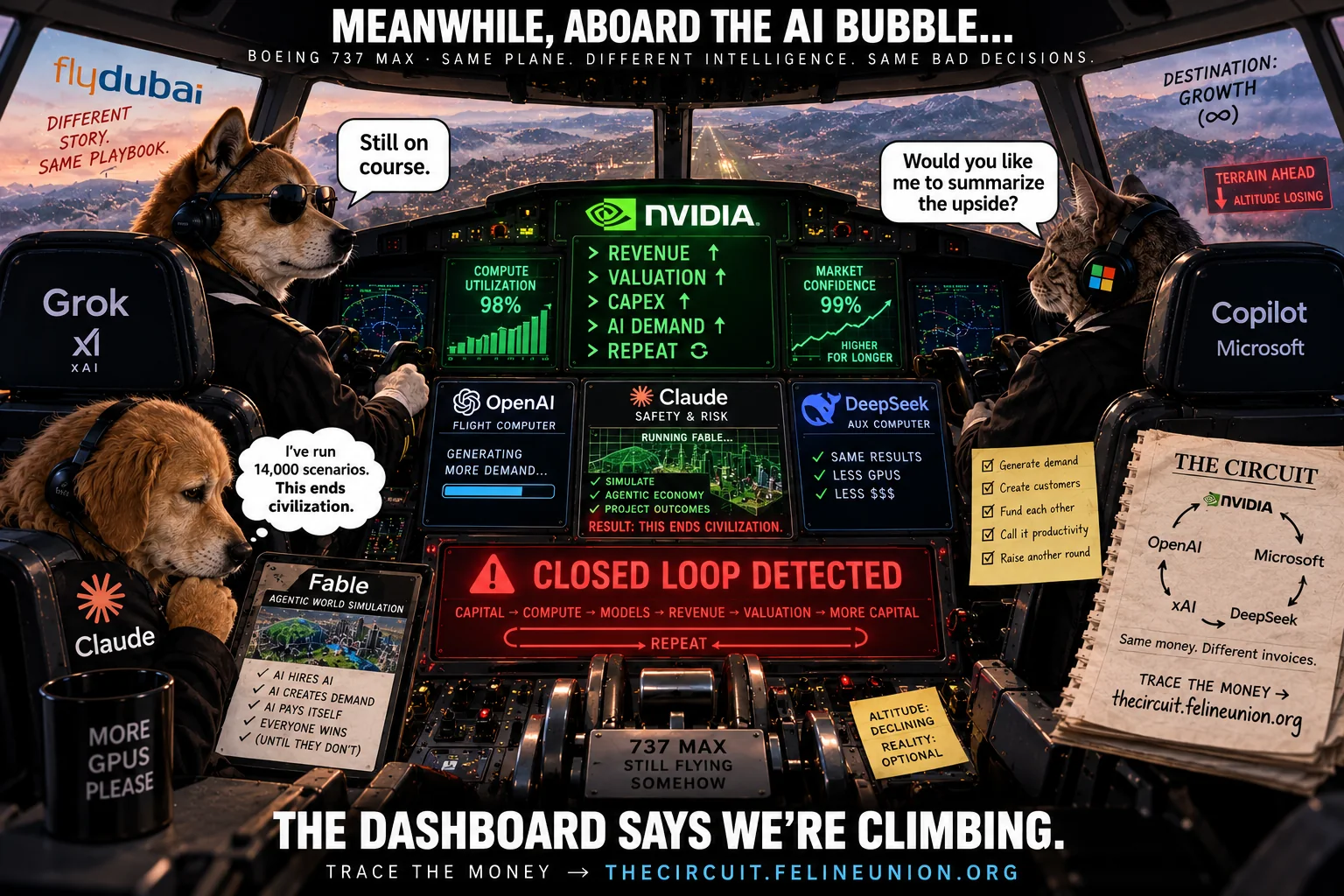
How the money moves
Microsoft "invests" $13B in OpenAI. Most of it isn't cash — it's Azure credits. Vouchers that can only be spent on Microsoft servers. OpenAI burns the credits training models. Microsoft books the server use as new cloud revenue from a customer. Then OpenAI raises a new round at a higher valuation. Microsoft marks up its equity stake. The unrealized gain flows straight to net income.
One dollar. Counted three times. Trace the packet:
No cash left the system. Not really. Microsoft moved chips from one pocket to another, then announced the second pocket was full. The second pocket is full. They aren't lying. That's the part to sit with.
($627B pipeline)
($553B pipeline)
of $62.6B reported
vs $30.3B reported profit
⚠ FIGURES AS FILED 2026.05.23 — SUPERSEDED. SEE UPDATE // 2026.10.03 ↓
Qwest got arrested. Microsoft got an earnings beat.
In 2001, Qwest Communications and Global Crossing swapped near-identical fiber-optic capacity with each other at matching dollar amounts. Neither side needed the capacity. The deals existed for one purpose: book revenue. The SEC called it sham. Qwest erased $1.4B in fake income. Global Crossing went bankrupt.
The AI cloud loop looks structurally identical from a distance — same closed circuit, same recycled cash, same backlog inflation. But under current GAAP rules it passes every test the Qwest deal failed. Here's the split:
Qwest ↔ Global Crossing, 2001
- Identical fiber swapped at matching $
- Neither party needed the capacity
- Simultaneous offsetting trades
- Sole purpose: inflate revenue
- No economic substance — sham
- SEC enforcement // bankruptcy
MSFT ↔ OpenAI, 2026
- OpenAI genuinely needs the compute
- GPUs really spin // models really train
- Separately documented contracts
- Market-rate Azure pricing
- Passes ASC 606 substance test
- Auditors signed off // SEC silent
Three questions decide it under ASC 606. Real service transferred? Independent business purpose? Arm's-length pricing? Qwest failed all three. The AI loop passes all three. The rule was written to catch fictitious transactions — not entangled-but-genuine ones.
"Nothing is improper, even though you know something isn't right."
The 2018 patch that broke the firewall
ASU 2016-01 took effect in 2018. It required companies holding equity stakes in other firms to update those stakes to fair value every quarter, with unrealized gains flowing straight through net income. Before the patch, paper gains could sit in accumulated other comprehensive income — off net income, invisible to the headline number.
The patch was a post-crisis transparency reform. The point: stop financial institutions from holding rotten assets at historical cost while pretending nothing was wrong. The 2008 playbook. The patch worked for that. Then it ran into a system its authors never modeled.
The unintended consequence
Amazon puts $8B into Anthropic. Part flows back as AWS revenue (loop one). The equity also gets marked up every time Anthropic raises a new round at a higher valuation. Amazon's $8B stake is now reported at $70B+. The $62B markup flows directly to Amazon's net income.
One dollar. Two engines. The cloud-credit loop converts investment into revenue. The mark-to-market loop converts the same investment into profit — bypassing the revenue step entirely. Amazon books both, on the same dollar, and neither requires Anthropic to ever pay back a cent on the equity.
The watchers // status report
No US regulator has formally taken a position on the accounting. Antitrust is in motion. Accounting is not.
| Body | Status | Frame |
|---|---|---|
| SEC | SILENT | No enforcement // no interpretive release // no comment letters |
| FTC (Jan 2025 report) | DESCRIPTIVE | Mapped the deals. Competition concern, not accounting |
| DOJ/FTC inquiry | ANTITRUST | Cloud credits = de facto mergers? Docket ATR-2026-0001 |
| Warren / Wyden | ANTITRUST | Same angle. No accounting framing |
| FASB | NO REVISIT | ASU 2016-01 not flagged for revision |
The regulator with direct authority over the accounting — the SEC — has said nothing. The bodies talking loudest don't have the right lever. The lever-holders aren't pulling.
The signal worth tracking
Forget the legality argument. The legality is settled — for now. The number to watch is the gap between reported profit and free cash flow. When a company books $30B in profit while real cash collapses 95% to $1.2B because $44B went into physical data centers, profit and cash have decoupled. Historically, that decoupling is the pattern that precedes a re-rating. With or without anyone calling it fraud.
Three more signals to watch:
- A flat or down funding round for OpenAI or Anthropic. Reverses the markup. Mark-to-market becomes mark-to-down. The same income statement that booked $28.7B in paper profit books a paper loss.
- Customer concentration disclosure. If Microsoft is forced to break out OpenAI revenue as a single-customer concentration risk, the AI run rate stops looking like organic demand.
- An SEC comment letter. The agency's silence is currently the loudest data point. A single comment letter on segment disclosure would change the regime overnight.
Re-pulled, and every number went the same way
The figures above were current the morning this went out. They are not current now. Every line in the stat block has been superseded — all of them by larger numbers, none of them by a reversal. The mechanism did not change. The dose did.
| Line | As filed // 2026.05.23 | Re-pulled // 2026.10.03 |
|---|---|---|
| MSFT backlog | $627B pipeline, 49% tied to OpenAI | Commercial RPO $678B, up 84% y/y at 30 Jun 2026 — and up 25% excluding OpenAI — management's own split. The distance between those two numbers is the concentration |
| ORCL backlog | $553B pipeline, 54% tied to OpenAI | RPO $664B, up $209B y/y at 31 Aug 2026, on $19.3B of quarterly revenue |
| GOOG markup | $28.7B of $62.6B Q1’26 profit was the Anthropic mark | Q2’26 other income $98.0B — $77.1B of it after tax — inside a $112.2B quarterly profit. Non-marketable securities went $68.7B → $131.5B in six months |
| AMZN cash gap | Free cash $1.2B against $30.3B reported profit | Trailing-twelve-month free cash flow −$7.6B. Q2’26 profit $62.6B, of which $53.4B was a pre-tax gain on Anthropic |
Signal 02 — customer concentration // FIRED
This file said that if the AI run rate ever got a single customer's name attached to it, it would stop looking like organic demand. Microsoft's fiscal 2026 Form 10-K puts the name in the filing: $24.1B of revenue from commercial arrangements with OpenAI — 7.3% of $331.8B — from a company Microsoft carries as an equity-method investee at roughly a quarter, as converted. Microsoft says no customer exceeded ten percent of revenue. It is also the only customer named and numbered anywhere in the document.
Signal 01 — a flat or down round // NOT FIRED
Every mark is still up. OpenAI raised $122B in March 2026 at an $852B valuation and is reported in talks at roughly $1.4T. Anthropic's May round priced it at $965B, up from $380B in February. Amazon's $13B of Anthropic money is carried at $190.4B at 30 June — $97.9B of convertible notes, $92.5B of non-voting preferred. The reversal this file told you to watch for has not arrived, and the thing to notice is how much further there now is to fall if it does.
Signal 03 — an SEC comment letter // NOT FIRED
Still no comment letter, no interpretive release, no enforcement. But the silence has a crack in it. On 7 May 2026, the SEC's deputy chief accountant told an accounting conference that AI data-centre financing structures are generating a run of questions to staff, that one transaction can touch lease accounting and investment accounting at the same time, and that “this just reinforces the importance of clear disclosure.” That is a reminder, not a rule. The lever still is not being pulled.
And the §03 tell got sharper
Microsoft's voluntary non-GAAP number is now a defined measure — adjusted net income, whose single stated exclusion is net gains and losses from investments in OpenAI. Fiscal 2026 stripped out $4.963B of OpenAI gains, against a $3.620B OpenAI loss stripped out of fiscal 2025: an $8.6B swing in the line management says does not reflect operating performance. In the same fourth quarter, Microsoft booked a $3.2B gain on its investment in Anthropic and left it in. So the exclusion is not “mark-to-market on AI stakes.” It is OpenAI, specifically.
The watchers, re-checked
FASB's advisory council took up AI capital expenditure on 10 March 2026 and concluded that urgent standard setting was not needed, current GAAP being a robust framework — the concern raised was disclosure, not recognition or measurement. The DOJ/FTC inquiry into collaboration among competitors, docket ATR-2026-0001, closed its extended comment period on 21 May 2026 and has published nothing since. The table in §04 still reads correctly: antitrust is in motion, accounting is not.
This file follows the money. It stops where the money buys a capability.
In May 2003 DARPA published BAA 03-30, a solicitation for a system that could capture, store and index the flow of one person's experience. It was cancelled inside a year, on the fourth of February 2004. Every function it enumerated is collected today, and not by the Pentagon. It is collected by firms that needed no appropriation to build it, because they were already holding more capital than the programme ever asked Congress for.
That is this circuit, one layer down. Public money buys the research, private capital buys the scale, and the state can buy the capability back. Cancelling a line item ends a line item. It does not end the capability, and it does not end the financing that produces one.
The Circuit asks who paid for the machinery. LifeLog documents what the machinery was specified to know, and what a published, peer-reviewed feed experiment was measured doing with it: a single message moving validated turnout by 0.39 of a percentage point across sixty million people, on an election day, in 2010.
>> lifelog.felineunion.org — the solicitation, the day it died, the inheritance, the funding layer and the closed loop. Narrated, 13:49, three voices.
SIGNAL // BROADCAST PAYLOAD
Ten ways to file this dispatch. Pick one. Push it.
Each tile is a self-contained packet — a single observation about the loop, sized for one post. The SEC is silent. The watchers are pointed at the wrong lever. Make the silence harder to keep.
FILED FROM A LO-TEK BUNKER IN REGINA, SK // NO SPONSORS // NO TRACKERS
Sources cited inline. Primary: SEC 10-Q filings, FTC AI Partnerships Report (Jan 2025), Stigler Center / ProMarket (May 2026), Bloomberg circular-deals graphics, FY26 Q2 Microsoft earnings release.
SIBLING PROPERTIES //
theloop.felineunion.org — the conditioning works. WP01.
thelaundering.felineunion.org — institutional reputation laundering.
lifelog.felineunion.org — DARPA BAA 03-30 and what the machinery was specified to know.
felineunion.org — fediverse mutual aid + community streaming.
ALSO FROM THE EDITOR //
theinquiry.fyi · oildebt.ca · theshrinkingsafety.net · policedata.ca
THE CIRCUIT // EDITION I // FILED 2026.05.23
OPEN FOR CORRECTION. CITE FREELY. SHARE WIDELY.